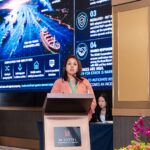
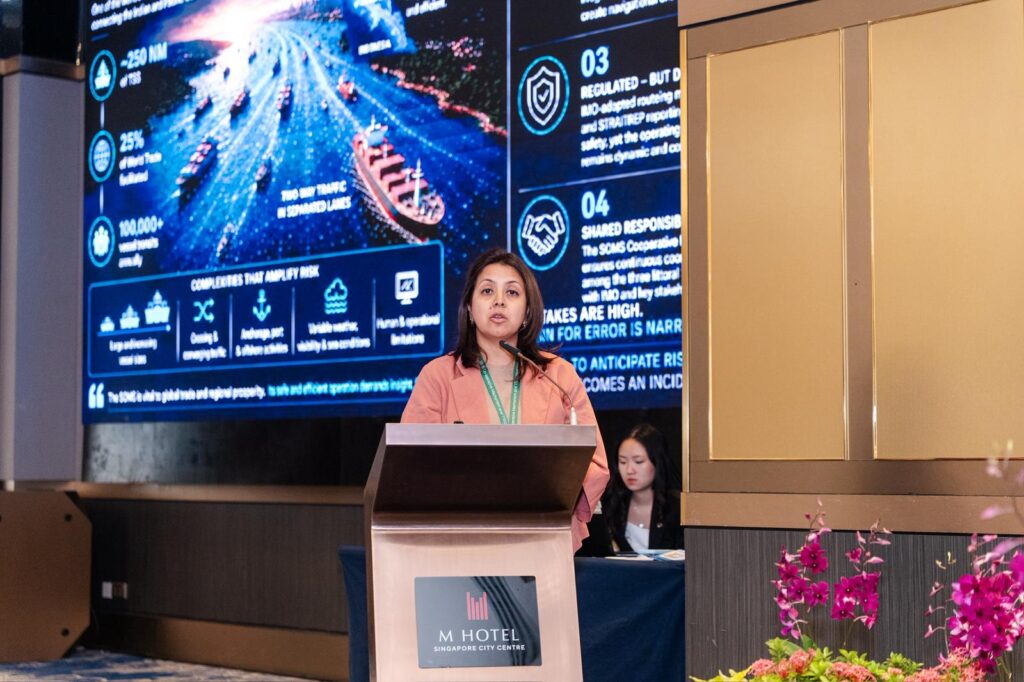
SimPlus Pte. Ltd. was honoured to be invited to share its expertise at the 17th Session of the Co-operation Forum, where its Managing Director, Stuti Nautiyal, presented how advanced technologies can enhance navigation safety in the Straits of Malacca and Singapore (SOMS).
Representing SimPlus, Stuti Nautiyal introduced the company’s approach to analytics- and simulation-driven decision support, demonstrating how maritime data and advanced technologies can help stakeholders better understand increasingly complex vessel traffic and make more informed decisions to support navigational safety.
A key focus of the presentation was transforming large volumes of Automatic Identification System (AIS) data into actionable maritime intelligence. Through advanced analytics, vessel traffic data can be used to identify traffic patterns, detect emerging risks and provide deeper insights into the interactions between vessels operating in one of the world’s busiest waterways.
Stuti also introduced the SimPlus Simulation Framework, a scalable approach that combines traffic volume growth modelling, synthetic vessel generation, machine-learning-based vessel trajectory modelling and dynamic collision avoidance based on the International Regulations for Preventing Collisions at Sea (COLREGs).
The framework enables future traffic scenarios to be explored across flexible time horizons, supporting both immediate operational decision-making and longer-term strategic planning. By modelling potential changes in traffic volumes, vessel characteristics and navigational behaviour, stakeholders can assess how future developments may affect the safety and efficiency of maritime operations in the SOMS.
The presentation also included a practical demonstration of SimPlus’ Navigational Safety & Near-Miss Analytics, illustrating how operators can move from a high-level overview of vessel traffic to the detailed investigation of critical encounters between vessels.
The platform enables near-miss events to be systematically ranked, representative vessel pairs to be identified, and individual encounters to be reconstructed through interactive 2D and 3D playback. Dynamic safety metrics, including Distance at Closest Point of Approach (DCPA), Time to Closest Point of Approach (TCPA) and COLREGs compliance, provide additional insights into vessel interactions and the factors contributing to potential navigational risks.
“Technology has an increasingly important role to play in helping the maritime community make sense of the growing volume and complexity of vessel traffic data,” said Stuti Nautiyal, “By combining maritime intelligence, advanced analytics and simulation, we can provide stakeholders with meaningful decision support for understanding current risks, exploring future scenarios and enhancing the safety and resilience of navigation in the Straits of Malacca and Singapore.”
SimPlus remains committed to leveraging maritime intelligence, advanced analytics and simulation technologies to support safer, smarter and more resilient maritime operations. Through continued innovation and collaboration with maritime stakeholders, the company aims to contribute to the sustainable and safe development of one of the world’s most strategically important waterways.
About SimPlus Pte. Ltd.
SimPlus Pte. Ltd. is a Singapore-based technology and consultancy company specialising in maritime simulation, analytics and decision-support solutions. By combining maritime domain expertise with advanced data analytics, artificial intelligence and simulation technologies, SimPlus supports stakeholders in addressing complex operational, safety and planning challenges across the maritime sector.
About the Co-operation Forum
The Co-operation Forum is an important platform for dialogue and collaboration among the littoral States and user States of the Straits of Malacca and Singapore (SOMS), as well as relevant international organisations and maritime stakeholders. It forms part of the Co-operative Mechanism on Safety of Navigation and Environmental Protection in the Straits of Malacca and Singapore, which was established to promote practical cooperation in maintaining navigational safety, protecting the marine environment and ensuring the continued sustainable use of these strategically important waterways.